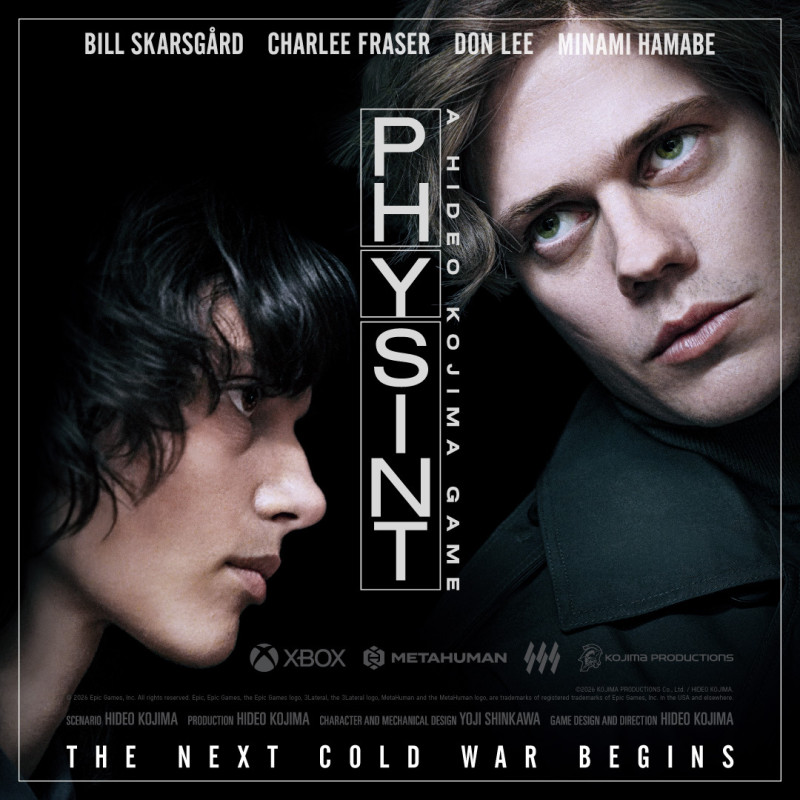
Bill Skarsgård’s PHYSINT clothing could be really interesting if we look at it as a layered smart-textile system rather than just a traditional spy outfit.
VIDEO GAME CONCEPT DEV DOCX +
Bill Skarsgård’s PHYSINT clothing could be really interesting if we look at it as a layered smart-textile system rather than just a traditional spy outfit.

With Metal Gear it uses codenames Solid Snake, Liquid Snake, Revolver Ocelot, Psycho Mantis, and Decoy Octopus are descriptive callsigns; the name tells you something about the character.
Death Stranding: the name sounds odd using ordinary modern words, but its occupational meaning becomes relevant again. “Sam Porter Bridges” sounds like a normal surname until you realize that Sam is literally a porter. The old relationship between name and occupation has been restored, making the name feel simultaneously archaic and futuristic.
Physint could take this in a more spy-oriented direction. Rather than occupational surnames, we may see codenames functioning as identities that can change, persist, or eventually be replaced, much like Snake becoming Big Boss, or Solid Snake later becoming Old Snake.
Depending on the world in which it is set, PHYSINT could approach naming in several different ways.
If it takes place in the far future, like Death Stranding, a similar naming convention might already exist within the culture. If it is set in a more contemporary or near-future world, however, the names might sound quite ordinary. Codenames could also be more mundane, depending on the circumstances in which the characters find themselves. Rather than using elaborate aliases, NOCs might operate under fake names, callsigns, or both.
If the game is set in a smart city or surveillance state, using an obvious codename could itself flag someone for investigation, especially if spoken language is being tracked at all times. Characters might have to discuss unrelated subjects to disguise what they are really saying unless they are in a blind spot in the system.
Codenames could be kept deliberately innocuous and tied to a social framework, functioning more like gamer tags, usernames, or email addresses.
For example:
X_kill_lot_X
SolidSnake@.ID
The “@” and “.ID” might not be spoken at all. Instead, they could become suffixes, like “-san” in Japanese, or function as markers with their own pronunciations. They might even be pronounced differently depending on the context, such as "add-odd"
If they have codenames, my vote for the two main characters would be “Hide” and “Seek.” For example, Bill Hyde and Charlee Seik could be their NOC identities, or the last names could be swapped between them. The alternate spellings make them look like conventional surnames while preserving the “hide and seek” connection and making the names feel like deliberate aliases. This would be like a Mulder and Scully type of deal. I've I spoke about this in a previous POST.
Example of NOC cover
Their NOC cover could be a company creating Immersive Reality (IR) a medium combining games, film, and real-world spaces. In the industry, it’s called IR; on the street, “I Am.” Its creators are Immersive Reality Architects (IRAs), and in this imagined history, Kojima is regarded as the father of the medium.
IR uses the surveillance network itself as part of the creative process. Because the system is constantly tracking people, locations, movement, and sound, IRAs can use that information to build live, location-based scenarios in real space and time (RST). A scenario might exist at a specific location, where other players travel there to experience the same environment or navigate a deliberately constructed situation.
These scenarios can be shared live. These would be similar to internet challenges today where "I AM" would be socially compelled to do the most viral IR at the time. "I AM" player could relocate or recreate them elsewhere using the same assets, rules, and boundaries. Some experiences are designed for a specific location; others can be transported anywhere. If this new media set in a world where global travel is free, fast and unrestricted, the entire planet effectively becomes part of the medium.
That gives the NOC an unusually legitimate reason to be everywhere, record everything, communicate in coded ways, and interact with the surveillance system
because they’re supposedly just creating the next generation of entertainment.
The surveillance state would also use this fad to elevate certain types of viral behavior and create viral content as propaganda.
This would stack two different games on top of each other: the one where you're making content and the one where you're doing the espionage.
A surveillance state could be interesting, but also tricky depending on how heavily it’s used. It’s been done before, and I could see Kojima wanting to move away from his previous works and do something new. At the same time, he might want to make something that wraps everything up too a proverbial epilogue to his body of work.
DONE IN THE SPIRIT OF PLAY
People often meme on Kojima’s DS character names because they sound strange or overly literal. But there may be a reason they feel so unusual.
Historically, surnames were often occupational: Smith, Baker, Cooper, Porter, and so on. Over time, those occupations became disconnected from the names themselves. The occupational meaning has effectively disappeared. A Smith could be a doctor, and nobody finds that strange because “Smith” is simply a surname now.
Death Stranding: the name sounds odd using ordinary modern words, but its occupational meaning becomes relevant again. “Sam Porter Bridges” sounds like a normal surname until you realize that Sam is literally a porter. The old relationship between name and occupation has been restored, making the name feel simultaneously archaic and futuristic.
That's what makes Death Stranding's names particularly uncanny: we're accustomed to surnames having lost their original meaning, and Kojima makes that meaning relevant again.
PHYSINT
Theoretical concept art of Bill Skarsgård’s PHYSINT character.
Poncho Paraglider Functionality
PHYSINT
Theoretical concept art of Bill Skarsgård’s PHYSINT character.
Turtleneck Mask Functionality
The notion that all of his civilian raiment has an ancillary espionage function. His turtleneck is primarily designed to obscure his Stealth Suit and provide added neck protection via blade-resistant cloth, with the ancillary functionality of quickly concealing his face.
It could be pulled up to fully cover his face if he has the means to see through it. Like via personal “droid” could provide a third-person POV, displayed on the inside of the turtleneck or perhaps directly in their mind’s eye via a Kojima-fied “Neuralink.” or Temporoparietal junction stimulation inducing customized out-of-body experiences via technology or “psychic” phenomena.
This is also mentioned in this POST but with context of Bill poncho.
Respirator
Smart textile multilayer nanofiber/electrostatic membrane this is for high-efficiency filtration and breathable air intake.
The lip and neck of the turtleneck have a shape-memory elastomer that creates a seal for a smart respirator. The filter covers the full garment surface, adding redundancy and allowing rapid air intake. An internal oxygen supply can also be connected to any point on the garment's surface through integrated connection ports.
Bill's stealth suit could have a small, thin smart air supply that can refill itself when not in use. The cloth is hydrophobic and waterproof, closing its pores so that water cannot pass through it while still allowing air and vapor to move through the filtration system.
Bill can breathe normally through the suit's filtration membrane, and the external air supply provides additional breathable air when needed. If the small air supply is not enough, he can use an adapter to connect to a larger external air supply.
A sensor could also automatically detect when the external air supply is connected and regulate the airflow, pressure, and filtration between the garment and the connected supply.
Ninja Reed snorkel a thin, long tube with a buoy could be connected to the turtleneck to provide air directly to the mouth.
Gameplay
This would allow Bill to use the turtleneck and move through gas and other air contaminants, which prevents staggering, coughing, and any possible side effects.
Swimming and hiding in water if all of Bill's gear is made from a hydrophobic smart textile, then moving in and out of water could be done without leaving a wet trail that could affect movement or create extra noise.
This could be an upgrade so the player can experience the difference. This could also be a function that could be turned on and off.
So you could use the "wet suit" as a gameplay element, creating paths for targets to be led down into ambushes and traps.
DONE IN THE SPIRIT OF PLAY
This will be a work in progress. I will be slowly updating this. I want to jot down some notions and expand upon it. I'll have to see if I can turn it into a complete thought or theory.
Unreliable Narrator
The core concept this is based around is the idea that if I was going to make a game about an unreliable narrator, I'd want to encode what was real or not, or what type of information I was presenting. Like, this is a hallucination, or this is a poetic metaphor of what happened. Especially if the unreliable narrator has more than one reason to be unreliable. Which means each reason could have its own story
If you’re going to have an Unreliable Narrator, encode it so you can distinguish the types of information, either in a blatant manner or a hidden or subtle one. So they can be ordered unconsciously or subconsciously.
Examples:
Like, if all of the brainwashed encoded scenarios were placed next to each other, it would show that perspective. This would apply to possible head-shrapnel-causing-hallucinations scenarios and dissociative identity disorder scenarios, too. Some of these could be umbrellaed, with one actually creating the other, making a hierarchy of unreliable elements.
Visual Language Effects
▪︎ Particle effects
They do happen in the Paz scenes if we say that this is one of our cipher keys.
▪︎ Horizontal lens flare
Happens with pain or impact.
▪︎ Vertical lens flare
Happens with The Man on Fire / The Third Child.
▪︎ Barcode lens flare
Happens around technology.
▪︎ Red lens flare
This too happens in the Paz scene. Happens else elsewhere too haven't pinned down a full context for it
▪︎ Blue lens flare
This too happens in the Paz scene. Happens else elsewhere too haven't pinned down a full context for it
Audio Language
Audio cues also accompany a lot of the visual cues.
How to Encode
First one is finding a cipher key, which I believe is the Paz hospital scenes. The existing particles, thank you so much. and lens effects.
Now it's tricky to just say if every scenario with dust particles is not real, it might be too much.
It might be more like if multiple effects exist, then it's true. Distance of the dust particles and specific lens flare effects.
Though it could all mean that multiple unreliable cases are currently active.
■■■■
Visual Language via objects
Fan
Hellacopter
Walkman
Idroid
Fan = Hellacopter = fan
A ceiling fan in a room can be a metaphor of a helicopter or being in one if th fan is above there head.
Visual Language via objects movement
Walkman
Rotating objects:
Fan- Hellacopter - Walkman
Example:
Jacobs Latter
Fan = Hellacopter = Fan
Rotating Fan - Hellacopter left or right
Word play.
Homophone.
Fan: blows wind
Fan: a enjoyer of something " fan of a game"
PHYSINT
Loose concept art of Bill Skarsgård’s PHYSINT character.
The zipped-up poncho could be part of the stealth gameplay. It could have technology that allows the character to see through it in some manner.
A personal “droid” could provide a third-person POV, displayed on the inside of the hood or perhaps directly in their mind’s eye via a Kojima-fied “Neuralink.” or Temporoparietal junction stimulation inducing customized out-of-body experiences via technology or “psychic” phenomena.
This could be something specific to the character, a common type of clothing designed for flash weather events, or simply something that’s in style.
This has body bag vibes, ghost, Pyramid Thing vibes, which is a little on the nose with Kojima's previous projects.
It could be for stealth against AI via Monty Python’s Flying Circus Ministry of Silly Walks, or more like “The Ministry of Creepy Stalking,” doing The Movement with a rapid, glitchy, shuddering motion that simulates a frame drop or skip in reality, causing the “ghost” to violently twitch or “teleport” forward.
Famous film examples: the hallway ghost in Pulse (Kairo), the ghost of Kayako in Ju On: The Grudge, and the twitching doctors in Jacob’s Ladder. And Lisa in P.T. and other game. Basically, something that obscures your gait and mannerisms. This would elevate a ghost or supernatural aspect.
It would be cool to have ghost or cryptic nomenclature for espionage agents, especially if the current culture believed in them. And this is how they run their plausible deniability. The agencies could fake or genetically make these scapegoats to show to the public.
This could also confuse the player: “Are they actually a vampire, geist, lycanthrope, or just called that?” And maybe both are true to some extent if they have been modified or have tech that mimics it, or is close enough to make sense of the moniker.
Not sure if Kojima is done with AI or Neuralink/nanomachine-type stuff. Death Stranding feels like it has a subtext of this stuff in it. I like the notion of AI and its infrastructure becoming so common that it’s like the words “electricity” or “internet,” where it’s no longer considered high-tech anymore. The DS Chiral Network is like the new tech concept, which I hope exists in PHYSINT. I’m hoping it has a high sci-fi concept like DS did.
I am curious if PHYSINT is at all set in the DS universe, either pre- or post- or present, inside the cities/Knots, or if it’s in its own universe. I’m not sure how moving from PlayStation to Xbox would affect this. I’m pretty sure that Kojima Productions owns DS still.
I would prefer that it’s done in a state where Timefall isn’t a factor, if it is. I assume most people would want it in its own universe, though. I think I lean that way myself giving Kojima more freedom with the story.
Update 9•22•26
Mimic
Using the poncho to mask or, more precisely, mimic another person's movement, Bill could scan civilians' movement. The poncho moves and isolates itself to mimic them. So instead of selecting camo, we are selecting an individual's movement pattern. This could open smart doors and let Bill safely move through trespassing zones. It could also shroud a jerk around to obscure your movements. This, too, could add to the ghost vibes. It visually could look like low-poly animated noise or something high-poly.
It could also mimic rough shapes as well, helping blend into the environment, becoming a box- or trash-can-like shape. The length of it might be able to be adjusted to cover more of Bill's body, too.
[These could also apply to his trench coat and stealth suit as well]
There could be a timer involved with this due to the cameras tracking two of the same individuals, which would initiate an investigation into the two identical signals.
This, too, could be used on purpose to have the investigation team interfere with the individual. Or to draw the team to your location for some reason.
Bill may need to secure a scan and incapacitate the mimicked target. This, too, would add a timer unless Bill took extra precautions with the incapacitated individual. A full binding would consist of hands - legs - mouth - eyes - ears. A different mix of these would create a specific type of effect when the incapacitated individual wakes up, which can be used as part of the gameplay mechanics for interesting scenarios.
[I may add to explain the binding gameplay loop]
Another element could be that the mouth could be bound via sound cancellation. The individual thinks no one's hearing him shout outside of a bubble of influence, and this device could be retrieved.
[This could also apply to his trench coat and stealth suit as well]
Like, Bill could be the one who "rescues" them, giving him leverage on them. The individual could have their mouth, eyes, and ears unbound. They're able to see and hear their current situation and try to get help. If their voice-activated "phone" is stolen or being jammed and their location is out of the way, possibly near a dumpster, Bill could be pretending to throw something away. This would give Bill a good cover story that he was not the one who tied them up. You could have certain individuals be more suspicious, though. This could be a game choice where Bill can intimidate and interrogate, both as the one who tied them up and as a rogue who's taking advantage of their current predicament. "What's in it for me?"
Flare
Also having the ability to have something like IR-reflective material that would affect all types of camera sensors in the same manner. It would act like camouflage through disruption, becoming a flare from the camera's POV. So you become very visible, but unidentifiable. Possibly when reversed or via an OctoCamo-like surface function.
[This, too, could also apply to his trench coat and stealth suit]
Xipper
The poncho has a normal zipper on it, but in the game it could be something future tech. If the zipper can open and close at any point or multiple points but also has a strong closed state. For example, a hole where his mouth is can be held open in a fixed position so he's able to smoke and use the poncho at the same time.
This could also allow for quick enveloping of objects, coming open and then closing upon them. Also obscuring firearms, leaving just enough of a hole to shoot from, possibly creating a tighter grip or seal to the barrel of the gun. To make it easier to move around and stay concealed.
Parachute
This could allow the poncho to function like a small parachute. The poncho could be connected to a harness that lets Bill "Xip" it up fully and base jump with it most likely from buildings. Or his stealth suit is the harness and the poncho rigging can be linked and tied into his suit, allowing him to steer with the posture of his body. The poncho can be pulled and folded into a compartment on the back of Bill's stealth suit.
[I have some art of this that I will link when I post it.]
Climbing
Grabbing and climbing up walls would be nice if Bill does have a parachute or glider. Like Zelda glider + surface grab. A modern notion would be an electric-powered suction lifter system. Or something like we've seen in Mission Impossible: Ghost Protocol. Or a different explanation, like gecko tech or psychic abilities.
DONE IN THE SPIRIT OF PLAY
|❮NOC❯|
|❮Non-Official Cover❯|
Non-Official Cover In espionage, operatives under non-official cover NOC are agents who have no official ties to the government they work for and operate under covert identities within organizations. Another term often associated with this is "deep cover," which refers to intelligence agents whose true identity and allegiance are heavily protected. This contrasts with an operative under official cover, such as someone working through a diplomatic position, where they may have diplomatic immunity if discovered. NOCs do not have that protection. If captured, they can face severe criminal punishment because their government may deny any connection to them. This allows for plausible deniability but also means they may receive no official assistance or acknowledgment. Such an operative may be referred to as a NOC pronounced "nok" or an "illegal" in intelligence terminology.Kojima is no stranger to espionage themes, and it is reasonable to assume he has encountered the concept of NOC through years of researching Metal Gear Solid and other game ideas. Several MGS characters could arguably fit aspects of the NOC concept.
The idea of the player or an NPC being a NOC in OD creates an interesting possibility:
If every major character is a NOC, or even if only the player is, they wouldn't truly be themselves they would be playing a role.
If every character enters the same situation while each trying to maintain their cover, the pressure of maintaining a lie could slowly transform them into monsters. The "monster" isn't necessarily a creature it's the cover identity they have been given that can consum it's self. Because of the pressure and expectations placed on them by their cover.
This idea echoes the Stanford Prison Experiment, where participants quickly internalized the roles they were assigned. Although the study has been heavily criticized and is no longer considered reliable scientific evidence, it remains a well-known cultural example of how people can become deeply influenced by the roles they perform.
If everyone thinks there are all devils of a person, including themselves, it has the potential to generate a pissing contest of who can be the worst human being in any given .
Maintaining Your Cover
Being a NOC would involve more than simply avoiding detection. It would require:
Maintaining mannerisms and quirks. This could be via a dossier of character traits if X then Y. Similar to Phasmophobia Ghost, but you need to mimic the "Poltergeist" or whatever cover identity is like Cryptic Hunter or Psychic
Saying the right things in your dialogue choices. We could have opinions that range from 100% 0%, we are all trying to choose the dialog that 100% compatible with your cover. There could be a secondary layer where adding an inflection with color coding and emotes selecting which words are 🤔😅😡 with white - blue - green - yellow - orange - red on intensity runing 0 -100%.
Being competent a your covers talents via mini games dossier could give you clues to cheese these.
Acting, role-playing, maintaining your cover. Sounds close to Among Us. If OD was a multiplayer horror game, that could be interesting. It could actually manifest something like the Stanford Prison Experiment if everyone is an NPC. I could see games similar to this already accomplishing moments like that. Any role-playing game could.
If the NPC POV is what the player sees, then if their cover is something like a Cryptic Hunter or Psychic, their point of view could be warped by their expected perception. Breaking cover could allow you to see through the operative's POV. This could alter the context of things around you, adding to puzzles and conversations, but doing this may have drawbacks like making other suspicious of you.
This could work to Assassin's Creed's desynchronization mechanic. Breaking character or "breaking kayfabe" could have gameplay consequences, forcing the player to constantly balance authenticity against survival.
We play as the NOC, but we have an Operative hiding inside us. It has its own objectives. As the player, we only see the NOC's POV.
The NOC might experience blackouts where they suddenly teleport around the area or pass out and have to pick themselves up off the floor. There could also be moments where the environment changes in the blink of an eye, with slight spatial distortion due to the Operative not perfectly aligning the NOC with their original position.
When the Operative gains full control, we don't perceive it. Instead, we only notice that a chair has moved, a door has been opened, a task has been completed, music has been turned on, or puzzles have been altered.
The NOC would perceive this as a ghost or geist haunting or possessing them, especially if there are surveillance cameras that show them doing things completely outside of their control.
As the game goes on, it starts to seem like this ghost is actually helping you. It's leaving clues. For example, it turns a chair upside down to reveal a key taped underneath the seat. It opens a door to a specific position so its shadow or light frames something important on the floor or wall. It subtly points out puzzles you need to solve instead of giving you a codec call saying, "Hey, you should do this." The Operative is trying to silently assist you with a simple message: "Look."
It could even explain video game mechanics. When you fail a puzzle, it resets in the blink of an eye so you can try again.
Throughout the whole game, you would assume it's a ghost. Then, in the ending or one of the endings, it's revealed that the NOC was actually a sleeper agent.
At some point, you might gain the ability to let the Operative take control by pressing a combination of buttons. Technically, this could have been happening the whole time whenever you pressed those buttons, even at the beginning of the game. It would feel like the game's way of recentering the camera, but with an extra effect.
The NOC's perspective could also be designed to see things differently or ignore specific things. Expanding on this idea, the environment could be full of people other agents or staff members who are moderating the event. They could even show up on TVs but be completely omitted from what the NOC sees because their hypnotic conditioning edits them out.
They could also move objects and alter the hypnosis at any point. For example, certain people dressed in specific colors might become visible to the NOC but may not look like they actually do. An example could be the Woman in Red looking supernatural or off in some way.
If there are security cameras, or if the Eye Notes somehow act like cameras, TVs or other monitors could let you "change the channel" to see moments where you've been possessed.
The Operative could hold up signs with messages written on them.They could also spell things out with their body using YMCA-style poses, flag semaphore, or Morse code.
I'm not sure whether recorded footage would have audio. I could see recorded audio being omitted or edited throughout the entire game. Then, near the end or possibly in New Game+ you could get a way to activate it.
One reason could be that the cameras or Eye Notes only capture visual information. The TV speakers could also be broken, or the volume knob could need to be repaired by finding a TV knob or using a screwdriver to adjust it.
Another possibility is that the hypnosis prevents the NOC from understanding the Operative's speech, muting it or distorting it. They can hear the noises they make in recordings but not the spoken words.
These ideas would encourage a second playthrough where previously silent recordings now contain dialogue and clues, all with different explanations for why you can hear them now.
The Operative could also use Morse code in recordings. A more likely use of this would be the staff using Morse code through knocks, adding confusion or giving alternate directions.
But if we added a second NOC/Operative, they could also be affecting the scenario. They could be communicating through Morse code knocks. Both Operatives might know each other, which would add another interesting layer.
They could also be hypnotically omitted to some extent. They would only be visible to us when they have a scarf around their neck that is usually on their head. When the scarf is on their head, we only interact with their NOC or Operative personalities.
When omitted, they could seem more like a poltergeist messing with us, trying to get our attention knocking things over, shaking things, or pushing us around.
They could even be perceived as the big hand monster that forces us to pass out or as other monsters.
But if this second NOC/Operative is not omitted, this character could seem like they have two different personalities, which should feel very Silent Hill-like. Their Operative side would be interesting because they would seem conspiratorial, almost like a tinfoil-hat type of person.
Especially if they aren't talking to you directly because they know you're in NOC mode.
2nd Operative: "Am I glad to see you. My damn alt keeps getting me turned around in this place." ㅤ
Player: "Who, me? I don't think I know you."
2nd Operative: "Shit, uh... never mind. I thought you were someone else. My name's... is Evan... Evan. I'm Evan and you?"
Player: "Well, is Evan, I'm is Taylor. This might be a weird question, but do you know where we're at?"
2nd Operative: "Hold that thought...
2nd NOC: "What? Not again.
Player: "Are you okay?" ㅤ
2nd NOC: "You stay away from me! Door, where's the door? Locked. Other door... unlocked. Now where was I? Not here. Definitely not here. Left or right?"
Player: "What the hell was that?"
The main character's Operative could also write directly on walls. A good example would be the "Hello" message from P.T.
If staff exists, they could erase or edit these messages. This creates the idea of two ghosts fighting for supremacy while also confusing each other's actions.
The Operative is trying to leave hints and help the player, while the staff is trying to sabotage those hints. The Operative would have to pivot on how they help you. They would have to hide their communication from the Staff, acting more erratic to throw them off the scent. This would also confuse the NOC until we eventually get on the same page with the Operative.For example, I would always start and end my messages with a number and end with "onomatopoeia." All messages would contain a color. Every third word would be the actual message.
"One day there was something on the road to nowhere. It's us but not us, a little white dog. Bark!"
"There on to us us white Bark."
If there was a second Operative, they would add another layer because the player would never know which "ghost" is helping them and which one is interfering.
Note-taking would be another interesting dilemma that could also be covered by the omission. Notes on your phone don't show up, appear scrambled, or are just locked with a code. It creates the notion of gameplay leading into trying to figure out ways to send messages to each other in different ways.
It would be fun if this idea was actually a multiplayer co-op mechanic, that would also be interesting. The main issue with this is the game would have to have something happening during these moments.
If we take the notion of Hartman from Death Stranding, the co-op Operative could have a time limit window blocked out. The NOC player character could be watching a dream sequence or flashback similar to BB cutscenes in DS. These things could also be more playable scenarios.
They might even be happening in the same location, which would retcon your actions because you were dreaming at the time.
Possible endings:
- Possession Ending.
- Sleepwalking Ending.
- NOC Sleeper Agent Ending.
I'd like these takes on the NOC. Might need to circle back to this to expand some of the gameplay.
One idea I've been thinking about is something I call Coverdose or Cover Over Dose.
The longer someone remains in character, the more they begin to lose themselves.
The surreal imagery shown in OD faces appearing beneath skin, giant hands, and other disturbing visuals could all be manifestations of the character's cover identity.
Perhaps these supernatural events aren't objectively happening. Instead, the character experiences them through the lens of their assumed identity. To them, they are completely real, so they act like they are happening.
The player sees these cover hallucinations as reality because the game presents the world through the cover character's perspective, not the operative's.
Reality itself might remain perfectly ordinary.
Like Don Quixote, who genuinely sees giants where everyone else only sees windmills, the player's perception becomes inseparable from the protagonist's cover delusion.
This could even become part of a multiplayer element. One player might witness terrifying monsters, while another sees nothing unusual because they are experiencing a different acted-out mental state.
Players could even have the option to suppress the hallucinations, allowing them to see the ordinary world beneath the horror but this would be considered breaking cover.
Note: This is similar to the leaked game play tests game over text of "Game Over Dose"
If the opening of the game is itself an act.
If the player assumes the strange events in the game are simply products of their characters, cover identity. But what happens if the real world gradually stops behaving normally?
If reality slowly transforming into something resembling a slasher film or supernatural nightmare.
How would someone committed to maintaining their cover react?
Would they interpret genuine horror through the lens of their fabricated identity?
Or would the cover identity, or the operative themselves, have to censor reality in order to preserve both their cover and their sanity?
Perhaps acting delusional, seeing a fantasy-themed version of the world through their cover identity. If they can rationalize what they are seeing, they might perceive unicorns, colorful creatures, or whimsical explanations instead of grotesque monsters in certain situations.
Alternatively, the operative's mind could break after experiencing the real world, creating delusions based on either the cover identity, the operative's own subconscious, or both.
The operative's cover character could interpret events through different lenses:
- Supernatural.
- Scientific.
- Conspiratorial.
Or perhaps the opposite happens.
The character accepts the impossible as perfectly ordinary because acknowledging how bizarre reality truly is would shatter their mind or destroy their cover.
The cover itself becomes a psychological defense mechanism.
A central mechanic could allow the player to shift between two perspectives:
- The Cover - the role the character is performing.
- The Truth or Dropping Cover - reality as it actually exists.
Neither perspective would necessarily be completely trustworthy.
Watching the cover identity react to horrifying truths could become one of the game's most unsettling mechanics.
Eventually, the distinction between performance and reality begins to disappear.
The act becomes the truth, but that's only if you can still keep track of what is actually happening.
Especially if you can't break cover for long, you may only see fragments of the truth. Perhaps you can only see reality when no one is looking at you.
Those posted notes might count, though.
The "K"s in KNOCK might not simply be letters. They could function more like brackets, containing something with additional story or gameplay meaning.
Examples:
|❮NOC❯|
|〈NOC〉|
|◀NOC▶|
⏮ NOC ⏭
These symbols could reference video, audio, or other devices, suggesting that the word inside the brackets has a deeper meaning.
Other projects connected to OD or other creators could use the same bracket format:
|❮?????❯|
Using the brackets around ordinary words could indicate hidden meanings.
Like:
|❮deadbolt❯|
|❮object❯|
|❮nickname❯|
The biggest issue is that the symbol appears to clearly be a K, not a bracket. That weakens the NOC interpretation.
However, the reversed K could be intentional and help support the idea.
Considering how quickly the internet discovered that The Phantom Painlogo was connected to Metal Gear Solid, Kojima may be more careful about hiding connections and avoiding obvious reveals.
If KNOCK also means NOC, both concepts could coexist.
"As a creator, I always want to betray fans' expectations."
"Do the same thing as me. Betray your audience."
Kojima has a history of misleading his audience in interesting ways. Metal Gear Solid 2, Metal Gear Solid 3's marketing (such as the Game Informer coverage), P.T., and The Phantom Pain reveal trailer all played with player expectations.
These may have been early experiments that established a precedent, giving Kojima the freedom to contradict what players think they know.
This approach can resemble a form of intentional misdirection or "false advertising." It doesn't always work immediately because players experience the "phantom pain" of having their expectations challenged. In hindsight, however, those moments often become some of the most memorable and meaningful parts of the experience.
There's also a metagame before release. Fans spend months analyzing every trailer, trying to determine what the game really is before launch.
Will we figure it out before the game releases, or will the next trailer give it away?
Because of that, KNOCK or |❮NOC❯| might not be a pure horror game. It could instead be a horror-espionage game.
The horror aesthetic shown in OD could itself be a fake-out. Rather than being 100% horror, the game may incorporate a significant NOC (Non-Official Cover) espionage element.
Not necessarily in the style of *Metal Gear Solid* with special forces operatives or tactical espionage, but something centered around the concept of living under a fabricated identity—someone hiding inside a persona while navigating a specific situation.
That idea could naturally lend itself to a detective mystery.
Investigating environments, examining objects, piecing together clues, and questioning identities are mechanics that already overlap with horror games.
A NOC-focused mystery could combine psychological horror with investigative gameplay.
Potential MGS Spoilers
Click to reveal spoilerThe relationship between the player and the protagonist has always been one of Kojima's recurring themes, making the idea of a character "living under another identity" feel like a natural extension of concepts he has explored before.
Personal Note
After playing Metal Gear Solid: VR Missions especially the mission "Murder Behind Closed Doors"I have really wanted Kojima to make a full detective mystery game. OD might scratch that itch.
I would love to see puzzles with a wide range of difficulty: some that are straightforward enough for most players to solve, alongside others that are so cryptic and well-hidden that the community could spend years uncovering every secret.
Espionage stories are often built around conspiracy, intrigue, and hidden truths. A horror game centered on a NOC could naturally explore similar ideas, blurring the line between reality and paranoia.
Potential themes could include:
- Secret societies, cults, and occult rituals.
- Urban legends and modern myths.
- UFOs, unexplained phenomena, and conspiracy theories such as
- Project Blue Beam. Mind-control concepts inspired by projects like MKUltra or stories such as The Manchurian Candidate.
- Directed-energy or acoustic weapon theories, including the so-called "Voice of God" concept.
- The Mandela Effect and the uncertainty of memory and shared reality.
- The possibility that public figures or Hollywood actors are living under fabricated identities or serving as NOCs.
- Mask conspiracies, identity replacement, and clone conspiracies.
Many of these ideas share a common thread: questioning what is real, who can be trusted, and whether a person's identity is genuine.
Those themes fit naturally with both psychological horror and the concept of a Non-Official Cover operative, where deception, hidden identities, and manufactured realities are central to the experience.
This is probably a long shot, but it would be interesting if OD/KNOCK somehow connected to PHYSINT.
They could exist in the same universe, with OD laying the groundwork for PHYSINT or introducing concepts that later become important.
Console War
Imagine if OD told the story from one side of a conflict while PHYSINT told the story from the opposing side.
Instead of simply being separate games, they would become two different perspectives on the same events.
Possible Story
The player character could be a NOC (Non-Official Cover) operative connected to PHYSINT.
Alternatively, the events of OD could directly lead to the creation of PHYSINT or the organization behind it.
Connected Gameplay
One of the most interesting possibilities would be if the two games influenced each other.
Imagine something similar to Pong, where playing one game first affects your experience in the other.
Your actions could be recorded as a "ghost" that later appears in the companion game.
You might replay the same level from the opposite perspective, encountering the ghost of your previous playthrough.
Rather than being scripted, an AI system could analyze and mimic your decisions, making each encounter feel personal while still allowing for dynamic variations.
Kojima has already used ideas involving asynchronous players in Death Stranding.
A cloud-based system could store gameplay data, allowing your previous actions or even another player's actions to appear in your world.
OD KNOCK could experiment with these concepts rather than only being connected to later versions of OD.
And your past decisions might literally come back to haunt you, creating the feeling that your previous self is stalking or interfering with your current playthrough.
That idea reminds me of one of Kojima's comments:
"I want to scan a ghost for the first time, and I want to get an award for that."
If taken literally or metaphorically, it could hint at gameplay where players interact with echoes of themselves or others, blurring the line between horror, multiplayer, and espionage.
The player and pre-made characters like Snake or Sam could metaphorically be our own NOC.
There is a poetic connection between a NOC operative and the relationship between the player and a fictional game character. It creates interesting commentary on gaming and identity.
The opposite could also be true.
An operative losing themselves in their role or experiencing cover identity assimilation could work similarly: the player becomes absorbed into the identity of a pre-made character, adopting their personality, beliefs, mannerisms, and worldview.
A related concept is chūnibyō ("eighth-grader syndrome") in Japan, where someone takes on aspects of fictional characters or exaggerated personas.
In a similar way, players temporarily adopt the identity of a character while playing a game.
Potential MGS Spoilers
In Metal Gear Solid, there is a meta idea that Snake is possessed by a demon, which could be interpreted as representing the player. The player is essentially an outside force influencing the character.
The notion of a NOC being possessed by their cover, or them possessing the cover identity, has intriguing connections to supernatural horror and espionage.
The cover identity becomes something more than an act.
It becomes another self.
The idea of NOC fitting with horror because both are about uncertainty.
A NOC questions:
A horror game built around NOC concepts could explore not only fear of monsters, but fear of losing yourself in the duality of perspectives and becoming the monster yourself because it's what is expected of you.
WORK IN PROGRESS
Done in the Spirit of Play
SCI-FI HIGH-TECH NOC
Kontrol Link: "Neural Link" Agent or Assistant for an Operative
KNOCK - |❮NOC❯| - |❮ontrol NOC lortno❯|
^(In Norwegian and Danish, the phrase *lort nok* means "shitty enough" or "tough luck.")
Operative & Operator
Ver. 1 - The NOC Operative being a sleeper agent
Via Kontrol Link: "Neural Link," their NOC is unaware that they are a NOC. The Operative watches and impulse-steers the NOC. They also choose what to say. These suggestions are given from an AI Agent through the Kontrol Link: "Neural Link."
This Operative can slow down the perception of time, allowing for precise reaction control and AI-suggested guidance to mimic actions that the NOC should be able to perform.
The Operative sees the world through the NOC's POV, which is not the "real world." The Operative has to hide, "take cover to break cover." The NOC then blacks out, letting the Operative see the "real world" through their own eyes.
From there, they can sneak around but need a good hiding spot to switch back, or, even better, return to the first hiding place so the NOC's continuity isn't broken. It also kind of functions like teleportation, in a way. As long as the Operative is hidden, only the NOC would feel weird.
Breaking continuity would affect the mental state of the NOC, so some kind of sanity meter would be involved gameplay-wise. If it gets too full, the NOC's superstition might summon or render nightmares or bad luck into their POV. There would need to be some mechanic to help improve their sanity back to normal.
The Operative can also pause the NOC POV, let the Operative disconnect and shift to their POV, move around to gain specific information, then unpause the NOC, sending them back to that location, but with the new intel affecting their perspective of the universe.
Unpausing the NOC does retcon actions the Operative performed. Only putting the NOC to sleep lets their actions be kept and possibly altered via the passing of time. This keeps both POV universes' time in sync.
The game could also touch on a pseudoscience or real science that would support the notion where each person is the center of their own universe to some extent.
Each of our universes communicates with one another to help fill out the world, giving it something to reference as to what exists, basically using other people's POVs to stitch together a basic notion of what's around the main Observer that's beyond their perception. After all, this would be jaded by the Observer's worldview.
Shared spaces would create more of a synchronicity, having everyone experience the same thing but differently internally. Some of this stuff might tie into the need to hide or not be seen, or the question of whether not perceiving others desynchronizes you from others.
This could be a story realization or plot twist that even the Operative's POV isn't "real" either; it's only their version of it.
Being alone somewhere that no one has ever been before would have an interesting effect. Trailblazing that undefined area, only the Observer's expectations would affect it, creating a psychological liminal space that would react to your current vibe: down the rabbit hole, fairy ring, Oz, Neverland, or something that's nightmare fuel. Essentially walking down a psychedelic road.
If this system was also a possibility in the game, it could add another layer of craziness where parts of the game can lead to Backrooms type situations, if I'm understanding what the Backrooms is, I haven't seen it yet.
The notion of an astronaut who explores Novel Space a "Novelnaut" could be a story realization or plot twist that ultimately the NOC and Operative are tools to explore POVs of Novel Space. To be fair, this could also just be one of the endings, basically doing something similar to Silent Hill, where the ending isn't necessarily a fixed explanation.
Another story realization or plot twist would be that you are technically Astronaut because most of outer space would be Novel Space.
note: this could be a fun explanation for 2001 a Space Odyssey trippie events.
The NOC POV could be backed up in case they are killed or compromised; it can be reload to retcon the mishap.
If killed, the connection to the NOC is broken and shifts to the Operative. The Operative can then reload the NOC POV. This technically resets time for both the NOC and the Operative to that moment and retcons both of their actions, but all information is remembered by the Operative and the AI Assistant Agent. When the NOC is awake, technically the Operative is hiding inside the NOC's POV and displaces the Operative out of their universe.
This could also apply to the Operative, too, being able to reload. Initially, the player would not question this, but eventually this could lead to another story realization or plot twist that the Operative is technically an NOC too. Each subsequent |❮NOC❯| is the anchor that lets them reload back into their POV, reality.
Each character is the center of their own universe, allowing them to reload and retcon previous actions.
Metaphore
▪︎ Operative & Operator - Player & Player Character/Avatar
▪︎ NOC - Player Character
Operator
Ver. 2 – Similar to the first version, but an Operator remotely controlling the NOC off-site via Kontrol Link: "Neural Link."
The NOC could have multiple NOCs in them and a sleeping Operative that can be woken up to perform tasks on their own. This section of the game would be more like a movie; the player would lose control.
When the Operative is woken up, the Operator of Kontrol Link experiences a shifting POV that can be both in and out of body, and Heautoscopy, Autoscopy, POVs, even seeing in the body of other local entities, creating a 3rd-person POV of the Operative.
Sometimes the Operative experiences this with the Kontrol Link Operator, but typically they see from their normal POV.
The Kontrol Link can attempt to stimulate the link to reset or reposition the Operative POV, but sometimes no amount of stimulation seems to affect it. A pseudoscience explanation would be given as to why this shift in perspective exists, most likely dealing with the conflict between a Kontrol Link and the Operative. It's more stable with the NOC than the core personality.
This would work well with Kojima's cinematic eye, allowing him to choose where the default POV is and also lock it into place when he wants it to be fixed, creating cinematic moments with the Operator actors.
How I would perceive it being done is that there are trigger zones all throughout an area with timers on them. Zones would shift to new zones if the NPC Operative is woken up in that specific zone. A cutscene or cinematic moment would occur with some possible camera control, like stated above.
From here, the game could function via suggestion, possibly similar to the game République. 3rd-person stealth NPC guide gameplay with the ability to change the camera to fixed angles. This, interestingly enough, also looks like the leaked test footage of OD. With this version, the player would want to have the Operative return to the wake-up location to not freak out the NOC psyche, but there may be situations where it's needed to solve the puzzle. The player will need to do XYZ to recover the hit to their sanity.
The amount of cutscenes or cinematic moments could be quite insane, especially if Kojima uses even the bloopers, basically leaving nothing on the cutting room floor. Some of them could be long or very short. There could be a couple of different versions of the same thing, using different takes.
These would kind of feel like MGS Codec calls, where you can call someone in an area multiple times and get different responses until you exhaust them all.
I could see there being actions that would trigger new zones. So if you move something in the room or did XYZ, then hid and woke up the NPC Operative, it would have a cutscene reacting to that action.
Some of this feels like Death Stranding's save house private rooms, where Kojima let Norman just. riff and ad-lib to add fun scenes that react to the camera, player, or environment.
This concept would be scaled, not just having a normal cutscene, but having player-controlled situational cutscenes that can take place.
The loop of exploring in first person, then hiding, waking up the NPC Operative, experiencing a cinematic moment with possible camera adjustment, then shifting into 3rd person where you help guide the NPC Operative around, let them know the coast is clear, and change your 3rd-person POV for different angles and possibly back to first person. Finding a good hiding spot to wake up the NOC and put the NPC back to sleep. Using the intel gathered to move forward.
During these set cinematic moments or the 3rd-person guided gameplay, the NPC Operative could be having a conversation with the Operator. Have them fill them in and catch them up on the situation, making these situations closer to the MGS Codec.
The NPC Operative could have valuable commentary on the situation. The AI Assistant Agent could also provide banter between the NPC Operative and the Operator.
The 3rd-person POV glitch could also affect the NOC when there is Kontrol Link interference, or "inner-fearence," with a weird space or a "monster." This would allow Kojima to have cinematic moments with the NOC as well. The pseudoscience explanation would be that the phenomenon is interfering with the Kontrol Link. Other things could also create this effect, like the psychological state of the NOC.
Metaphor
▪︎ Operator - Player
▪︎ NOC - Player Character
▪︎ Operative - NPC
AI
Possibly with the cloud game, the AI might be an actual dedicated LM AI, or the game could be simulating the notion of one.
Depending if this game's online or offline, maybe both.
It would be kind of interesting if it also was VM reacting to what's on your screen. They had this, so I could see them using it for gameplay purposes as well to help make situations feel more cinematic and possibly replay a creepy event that was missed by the player.
Not sure SLM or SVM could do this task. The large models could have a PR problem if mandatory or implemented in OD.
Note: The concept of relinquishing control of a Player Character for a cinematic moment or full cutscene intrigues me.
This technically is what happens during a normal cutscene; the player loses control. But turning cutscenes into player-controlled gameplay moments and possibly puzzles.
I'm fascinated with the notion of framing the video game context as part of the story and canon, blurring the line of what it means to play a game. Giving cutscenes actual a in context is a intriguing idea.